
European Office of the Church of Scientology launches youth guide promoting EU VALUES

Online initiative explains EU values, the EU Charter of Fundamental Rights and the European Convention on Human Rights with official sources, scenarios and a self-check quiz
BRUSSELS, Belgium — 19 February 2026 — The European Office of the Church of Scientology for Public Affairs and Human Rights has launched “Europe’s Values, Your Rights”, a new online educational guide designed for young adults and written in plain language. The initiative brings together the European Union’s foundational values under Article 2 of the Treaty on European Union, the EU Charter of Fundamental Rights, and the European Convention on Human Rights (ECHR), with links throughout to official EU and Council of Europe materials.
The guide is built around a practical civic-literacy goal: helping readers understand not only what a right is, but also where that right sits in Europe’s institutional architecture and which body is competent in different situations. A recurring source of public confusion—the difference between the European Union and the Council of Europe—is addressed early, including a simplified map of who does what and when the Charter applies versus when the Convention and Strasbourg case-law become relevant.
At the core of “Europe’s Values, Your Rights” is an explanation of the six EU values—human dignity, freedom, democracy, equality, the rule of law and respect for human rights—presented with brief examples intended to help young adults recognise how values appear in everyday life: at work, in education, online, and in civic participation. The site anchors these explanations in primary texts, linking users to official documents rather than commentary.
A major section introduces the EU Charter of Fundamental Rights as a legally binding text, with a practical explanation of how it binds EU institutions and also Member States when they implement EU law. The guide directs readers to authoritative clarification such as the EU Agency for Fundamental Rights (FRA) overview of the Charter’s field of application and provides a structured pathway through the Charter’s themes—dignity, freedoms, equality, solidarity, citizens’ rights and justice—aimed at non-specialist readers.
In parallel, the guide outlines the purpose and scope of the European Convention on Human Rights, describing it as a Council of Europe treaty supervised by the European Court of Human Rights in Strasbourg. It notes, in general terms, the principle that applicants normally turn to domestic remedies first and then assess Strasbourg admissibility in line with the Court’s official guidance. The site underlines that it is an educational resource and not legal advice, and refers readers to official instructions and qualified support where appropriate.
Designed for mobile reading habits, the initiative includes a short learning layer: a six-question self-check quiz that tests basic competence and applicability (for example, when the Charter is binding), and a “civic toolkit” that points to established European participation channels and public-information mechanisms such as the European Citizens’ Initiative, the European Parliament petitions portal, and the Commission’s Have Your Say consultations, alongside youth programmes including Erasmus+ and the European Solidarity Corps.
Brussels, the EU capital: a long-running human-rights presence
The European Office notes that it has maintained a human-rights presence in Brussels—the capital of the European Union—since 1990, evolving in different forms over time. According to the Office, this work has served as a focal point for programmes intended to inform the public about the Universal Declaration of Human Rights and how its principles can support a humane and peaceful society grounded in respect for each individual.
That institutional focus is also described in the Office’s statutes. In the wording provided within its internal governance documents, the organisation defines itself as a religious association operating within European legal and human-rights frameworks. The statutes, approved and recorded at the Registry of Religious Entities of the Ministry of Presidency and Justice of the EU meber state Spain, state:
“Article 1.- An entity of organizational nature is constituted […] as a religious association abiding by article 16 of the Constitution, Organic Law 7/1980 of 5 July, on Religious Freedom, article 2.2.(c) of the Royal Decree 594/2015 of July 3rd, the Universal Declaration of Human Rights and the European Convention for the Protection of Human Rights and Fundamental Freedoms, under the name EUROPEAN OFFICE OF THE CHURCH OF SCIENTOLOGY FOR PUBLIC AFFAIRS AND HUMAN RIGHTS, vested with legal personality and full legal capacity, which shall be governed by the aforementioned regulations, the provisions set forth herein, and other applicable laws. Its territorial scope is national and European, and it shall act as an entity of reference for the entire European territory. It shall operate as a purely religious non-profit organisation, which shall be responsible for carrying out its own activities and act as a representative for the various Churches in Europe before national and supranational public and private institutions, fostering that which is set forth in article 17 of the Treaty on the Functioning of the European Union and pursuant to article 2.2 of the Organic Law on Religious Freedom, joining to the European values of Human Dignity, Freedom, Democracy, Equality/Equity, the Rule of Law and Human Rights […]”
The same statutory framing links the Office’s work to the structured dialogue foreseen under Article 17 of the Treaty on the Functioning of the European Union, which provides for open, transparent and regular dialogue between EU institutions and churches, religious associations, and philosophical and non-confessional organisations.
How the initiative frames Scientology’s ongoing contribution to European values
A dedicated section of the guide (“How Scientology communities contribute”) places the launch within a broader description of Scientology-linked community programmes across Europe that are presented as practical, day-to-day support for the same principles set out in Article 2 TEU. In the guide’s approach, “values” are treated less as abstract declarations and more as measurable civic habits—education, prevention and volunteering—that can reinforce human dignity, freedom, equality, the rule of law and human rights in local communities.
Within that framework, the guide links to programme areas described as active across Europe, including human-rights education, drug-prevention education, and community assistance through the Volunteer Ministers, alongside other social-betterment and rehabilitation initiatives referenced via Scientology Europe. The guide’s narrative connects these strands to a civic premise: rights protections are strongest when people understand them and communities invest in prevention and responsibility, reducing the conditions in which exploitation, discrimination and social exclusion develop.
Scientology and its founder L. Ron Hubbard are referenced in the initiative as the origin and inspiration for this long-running humanitarian approach, in which educational and social programmes are presented as complementary community-level efforts alongside institutional protections. The guide’s structure reflects that positioning: it begins with Europe’s legal frameworks and institutional roles, then situates community action—education, prevention and volunteering—within that wider European context.
Ivan Arjona, the Church of Scientology’s representative to the EU, OSCE, Council of Europe and UN, said: “Europe’s values become real when they are understood and practised in daily life. If young adults can clearly distinguish what the EU Charter does, what the European Convention does, and which institution is competent, they are better equipped to act responsibly, resolve disputes lawfully, and protect dignity and freedom—both for themselves and for others.”
Facilities supporting dialogue and community initiatives
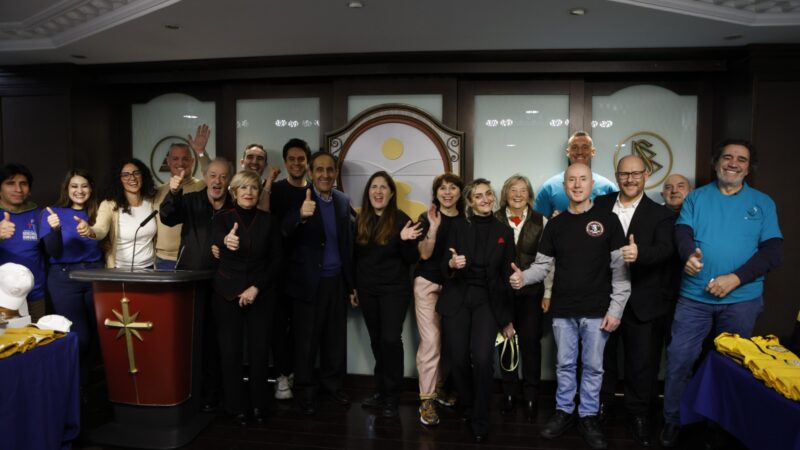
The European Office also notes that it has developed facilities in many European cities—citing Madrid and Brussels, alongside other capitals—to plan and coordinate initiatives intended to benefit communities in Europe and beyond. In that context, the Office states that its conference and meeting rooms are made available for seminars, round tables and related events held by human-rights and community-betterment organisations, consistent with the Office’s stated focus on dialogue and education.
The Brussels office is described as open to the public in line with the general practice of Scientology churches and related facilities, with public-facing information and educational materials accessible to visitors during posted opening times.
The Church of Scientology, its churches, missions, groups and members are present across the European continent. Scientology Europe reports a continent-wide presence through more than 140 churches, missions and affiliated groups in at least 27 European nations, alongside thousands of community-based social betterment and reform initiatives focused on education, prevention and neighbourhood-level support, inspired by the work of Scientology founder L. Ron Hubbard.
Within Europe’s diverse national frameworks for religion, the Church’s recognitions continue to expand, with administrative and judicial authorities in Spain, Portugal, Sweden, the Netherlands, Italy, Germany Slovakia and others, as well as the European Court of Human Rights, having addressed and acknowledged Scientology communities as protected by the national and international provisions of Freedom of Religion or belief.